Table of contents
Sidewalks, train stations, and civic plazas are turning into power points, as cities and venue operators race to add phone charging where people actually wait, linger, and commute. The promise sounds simple: less battery anxiety, more connected public life, and a small boost for local services. Yet each new charging unit also raises practical questions about clutter, accessibility, vandalism, and data security, because a public space is a shared asset, and technology rarely arrives without friction.
Charging arrives where people already wait
Convenience is the headline, and it is hard to overstate how quickly “no battery” became a daily problem in public life, because modern smartphones are not just phones, they are tickets, wallets, maps, work tools, and emergency lifelines. That dependency shows up in the market numbers: global smartphone shipments still measure in the billions over a typical two-to-three-year replacement cycle, and average daily screen time in many countries runs into multiple hours, which makes charging away from home a predictable need rather than an edge case. In response, transport hubs, shopping centres, universities, and municipalities have treated charging as basic infrastructure, joining Wi‑Fi and seating in the informal checklist of “stay longer, spend more, stress less”.
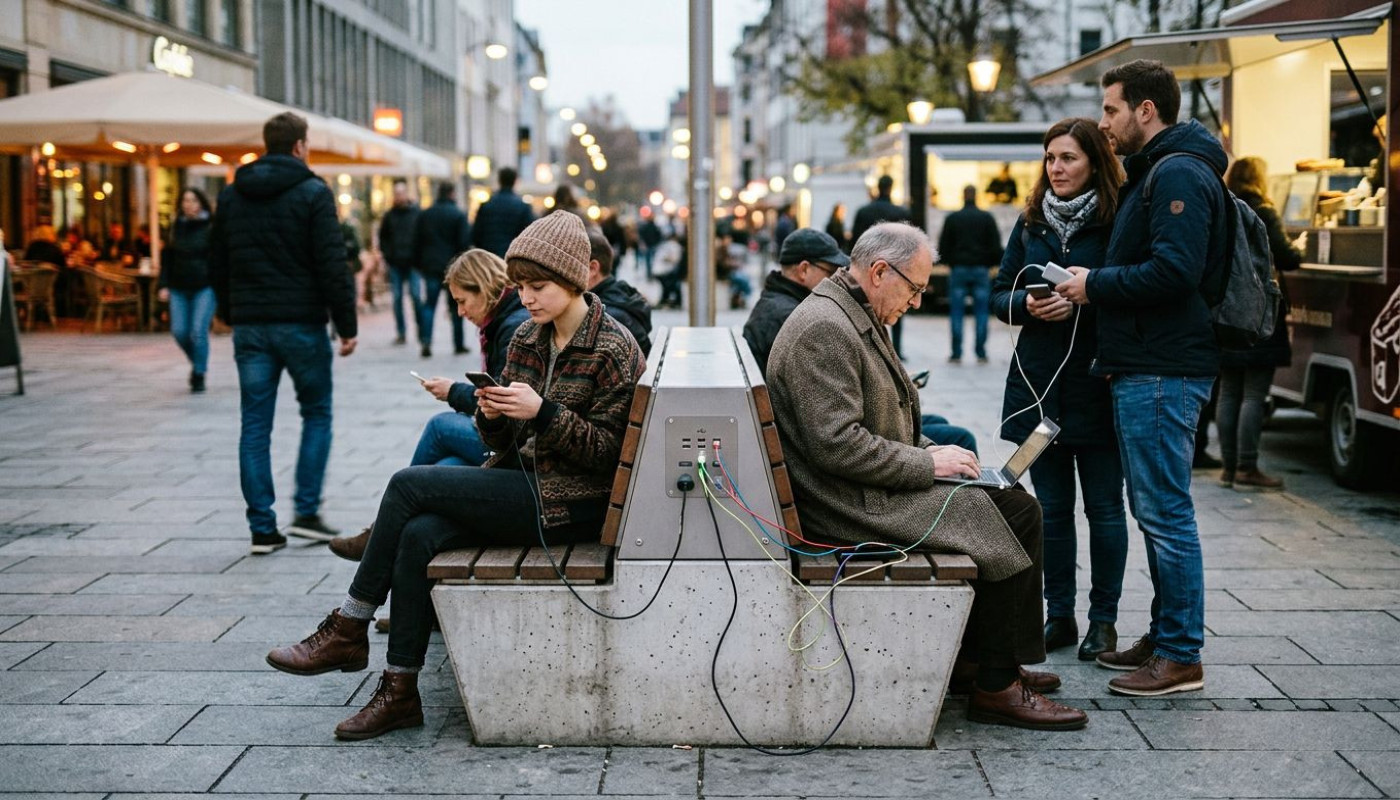
On the ground, the most visible change is not the presence of a single socket, it is the way charging gets packaged into public furniture, from benches and tables to freestanding stations. Many operators prefer integrated units because they concentrate cables, power management, and maintenance into a single footprint, and they can be placed where footfall already converges, such as concourses, food courts, and outside ticket lines. The strongest adoption has been in high-dwell environments, where a 10- to 30-minute top-up has real value, and where the business case can be measured in longer visits and improved customer satisfaction.
That is where purpose-built public charging fixtures matter. Operators are increasingly opting for modular systems that combine safe power distribution with robust casings, tidy cable management, and options for branding or information panels. For readers looking at concrete implementations of this trend, kiosks aventech illustrates how charging and public-facing design can be combined in a single unit, which is often the difference between an amenity that blends in and an installation that quickly feels like clutter.
The broader shift is cultural as much as technical. Charging in public used to be something you begged from a café, and now it is increasingly an expected layer of service, especially in places that want to look modern and “frictionless”. When expectations rise this quickly, failures become visible too, and that is why the debate has moved from “should we offer charging?” to “how do we offer it without degrading the space?”
Design choices decide harmony or clutter
What makes a charging installation feel harmonious is rarely the technology itself, it is the discipline of design: where it sits, how it routes people, and whether it respects the logic of the space. A plaza is not a showroom, and a train station is not a phone shop, so every added object competes with sightlines, circulation, and accessibility. Poorly placed units can create pinch points near doors and escalators, or encourage crowds to stop in unsafe locations, while overly bright screens and bulky housings can visually “advertise” themselves into being a nuisance. The most successful deployments read the space first, and the power needs second.
There is also a deeper question of inclusivity. Public amenities must work for people with reduced mobility, for those carrying luggage, and for users of different heights and reach ranges. That pushes designers toward comfortable cable lengths, reachable outlets, and stable surfaces, and it is why integrated solutions often outperform improvised ones, because they can be specified to meet accessibility norms and building constraints from the start. In practice, this means leaving clear walking paths, avoiding trip hazards, and ensuring that a person in a wheelchair does not have to position themselves awkwardly just to plug in.
Power delivery itself can nudge the design. USB‑A ports are still common, USB‑C is becoming standard, and wireless charging pads are attractive for simplicity, yet each choice has trade-offs in durability and user compatibility. Wireless pads reduce cable theft and tangles, but require the phone to sit still, and they can be slower depending on the standard and device. High-wattage USB‑C can deliver meaningful charging in a short dwell time, but it raises heat management and component quality stakes, especially in unsupervised environments. The best public setups offer multiple options, and they communicate clearly, because ambiguity is what drives people to awkward hacks, like unplugging other users or forcing connectors.
Then there is maintenance, the quiet determinant of whether a good idea survives. Public hardware lives a hard life: spilled drinks, dust, impacts, and constant plugging. If a unit looks broken, the surrounding area can feel neglected, and perception matters in shared spaces. Cities and venue managers therefore increasingly think in terms of total cost of ownership, not just purchase price, and that includes spare parts, cleaning, remote monitoring, and the ease of swapping damaged modules. Harmony is not achieved on opening day; it is earned through months of reliable service.
Security worries shift from cables to data
People have learned to fear the “public USB port”, and not without reason. Cybersecurity agencies and industry experts have repeatedly warned about the risk of “juice jacking”, a catch-all term for attacks that can exploit compromised charging ports or cables to access data or install malware. While real-world prevalence is debated and modern phone operating systems have improved protections, the concern has become part of public awareness, and perception alone can depress usage. In other words, a city can install chargers and still fail to deliver value if the public believes the ports are risky.
That pushes operators toward designs that separate power from data, such as power-only USB ports, AC outlets that let users plug in their own adapters, or clearly labelled systems that reassure users about safety. Communication is crucial, because users respond to signals: sealed ports, tamper-resistant casings, visible maintenance labels, and instructions that encourage using personal cables and locking devices when possible. The goal is not to promise zero risk, which is rarely credible, but to show that security has been designed in rather than bolted on.
Physical security matters just as much. Public charging equipment can attract vandalism, component theft, and opportunistic damage, especially where foot traffic is high and supervision is limited. This is where materials, anchoring, and enclosure design become policy decisions, because a unit that repeatedly fails becomes a recurring cost and a public irritant. Some operators integrate charging into heavier street furniture or interior fixtures to reduce the temptation and the ease of removal, and they locate units within sightlines of staff or cameras, which is less about surveillance and more about deterrence and rapid response.
Privacy questions also arise when charging stations add screens, connectivity, or payment features. If a unit collects usage metrics, displays ads, or offers services beyond power, then governance becomes relevant: what data is collected, how long is it stored, and who can access it. Public spaces are not private platforms, and citizens increasingly expect transparency. The safest route is minimal data collection, clear notices, and procurement contracts that define ownership and responsibilities, because ambiguity in a public-tech project tends to become a political liability.
Who pays, who profits, who maintains?
Follow the electricity bill, and the debate becomes clearer. A single phone charge does not consume much energy, yet scale changes the picture, because dozens of ports running all day, plus screens, lighting, and connectivity, can add up across a network of sites. For a municipality or a transport operator, the question is not only the cost of power, it is the staffing, cleaning, repairs, and the opportunity cost of space. The most sustainable projects treat charging as a service with a defined operating model, not as a one-off purchase.
Different funding approaches are emerging. Some venues offer free charging as a customer amenity, absorbing costs in exchange for longer dwell time and better satisfaction scores. Others pair charging with advertising, sponsorship, or partnerships, where brand visibility offsets installation and maintenance. In some high-traffic environments, paid charging still exists, especially when fast charging is provided or when lockers secure devices, but pricing must be handled carefully, because people compare it to free alternatives and may resent being “taxed” for basic connectivity.
The public-interest angle is more complex. Charging can be framed as digital inclusion, particularly for people who cannot reliably charge at home, or who rely on phones for work scheduling, benefits access, or navigation. In that sense, public charging resembles other civic amenities, but it still requires prioritisation, because every budget line competes with lighting, cleanliness, and safety. The strongest case is usually made when charging is integrated into broader upgrades, such as station refurbishments, smart-city rollouts, or street furniture replacement cycles, because it reduces incremental disruption and spreads procurement costs.
Maintenance remains the make-or-break factor, and it is where many initiatives stumble after the ribbon-cutting. A practical plan includes routine inspections, clear fault reporting, and spare-part logistics, and it assigns responsibility: is it the city, the venue, the contractor, or a third-party operator? When that is unclear, broken ports linger, and public trust drops quickly. Successful deployments also measure usage, not as a vanity metric, but to decide where units are needed, where they are underused, and where design changes are required to reduce damage and improve accessibility.
Making it work: booking, budgets, support
For venue operators, the first step is a site audit, then a pilot in one high-dwell area, and a maintenance contract with clear response times. Budgets should include installation, electricity, and yearly repairs, not just hardware. Municipalities can look for regional digital-inclusion grants or mobility-fund support, and they should publish simple user guidance on safe charging and fault reporting.
Similar articles